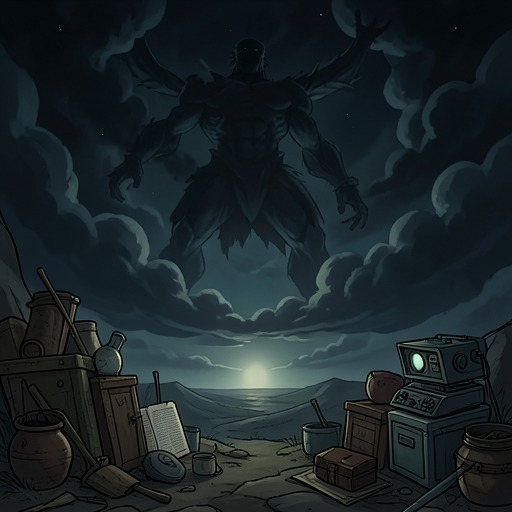
Satan
Book of RevelationSatan is the dragon, the deceiver of the world, and the accuser cast out of heaven after losing a war against Michael and his angels. In the book’s reading of Revelation, that defeat does not end his activity: expelled to earth and aware that his time is short, he directs his anger against the woman and her remaining children, while the wider prophetic sequence associates his wrath with persecution and the rise of the Beast government. After a thousand years of confinement, he is released to deceive the nations once more, but the final rebellion fails and he is cast into the Lake of Fire.## Identity and Narrative Role Satan appears in Revelation 12 under several linked descriptions: the great dragon, the ancient serpent, the Devil, and the deceiver of the whole world. The passage also identifies him as the accuser who had accused the faithful before God day and night. These are not separate figures in the book’s account but names that gather his functions into one antagonistic role: he deceives, accuses, opposes God’s people, and contests the authority of God and Christ.
The account gives Satan a place in a cosmic conflict, but the book’s interpretation emphasizes that this conflict has consequences on earth. His loss in heaven becomes the occasion for intensified earthly danger. The narrator in Revelation hears a heavenly declaration that salvation, strength, God’s kingdom, and the power of Christ have come; the announcement that the accuser has been cast down is at once a statement of victory and a warning to those on earth. Satan’s defeat is real, but it initiates a final, limited period of wrath rather than immediate inactivity.
The book treats the passage as part of a deliberately non-linear account. Its author argues that Revelation combines past and future events: the passage includes the birth of Christ, Satan’s expulsion, and the coming of a global government. This framework matters to Satan’s narrative role, because his expulsion is not presented simply as an isolated scene. It is a hinge that connects heavenly conflict to later earthly persecution and political upheaval.## The War in Heaven and Expulsion In the vision, Michael and his angels fight the dragon and his angels. The dragon does not prevail, and their place is no longer found in heaven. Satan and his angels are cast down to earth. The reversal is decisive: the one who had accused the faithful before God loses access to that heavenly position, and a voice announces the accuser’s fall as a victory for God’s kingdom and the power of Christ.
The surrounding vision places this conflict beside the woman, her child, and the woman’s flight into the wilderness. Satan stands ready to devour the child when it is born; the child is caught up to God and his throne, and the woman flees to a place prepared for her, where she is nourished for 1,260 days. The text then describes the dragon’s defeat and expulsion before turning to his pursuit of the woman. The succession of images links the threat to the child with the later persecution of the woman and her descendants, while the wilderness passage gives the woman a period and place of protection.
The author reads the war in heaven as a past-and-future sequence rather than as a single event wholly located in one period. In his account, the passage reaches back to Christ’s birth and forward to Satan’s casting down and the formation of the Beast government. He also interprets the expulsion as the point after which Satan can no longer bring accusations against people before God. This is the author’s proposed chronology for the vision, offered within his broader claim that Revelation’s sections are not all arranged in chronological order.## Wrath and Persecution on Earth Once cast down, Satan is described as having great wrath because he knows that his time is short. The book connects that limited remaining time to his pursuit of the woman and her children. He persecutes the woman, attempts to sweep her away with a flood, and is thwarted when the earth helps her and swallows the flood. When the dragon cannot overcome her, he turns to make war on the remnant of her offspring: those who keep God’s commandments and hold the testimony of Jesus Christ.
The author relates this persecution to Daniel’s description of a period in which the enemy is allowed to make war on the saints for three and a half years. He understands that period as part of the larger Great Tribulation, which he treats as Daniel’s seventieth week: a seven-year period composed of two distinct halves. In his account, the first 42 months end at the rapture; he calls the following period, when God’s wrath is poured out, tribulation for the unrepentant as well. He acknowledges that some readers reserve the name Great Tribulation for the first half and call the second half the wrath of God, but considers the full seven-year span the essential point of agreement.
The sequence also connects Satan’s rage with the emergence of the beast from the sea. The author reads Revelation 12’s account of the dragon’s pursuit alongside Revelation 13’s vision of a beast with seven heads and ten horns, taking the latter as the coming Beast government. He links Satan’s attack on the saints to the larger end-times order without treating the dragon and the beast as interchangeable figures: Satan is the hostile spiritual power, while the beast represents the political structure that appears in the next vision.## Confinement and Final Rebellion Satan’s activity is interrupted after the events associated with Christ’s victory. An angel descends from heaven with the key to the Abyss and a great chain, seizes the dragon, and binds him for a thousand years. He is cast into the Abyss, which is shut and sealed over him so that he cannot deceive the nations during that period. The restriction is explicitly temporary: after the thousand years, he must be released for a little while.
When that time ends, Satan is released and again takes up deception. He gathers the nations from the four corners of the earth, identified as Gog and Magog, for battle; their number is described as vast, like the sand of the sea. They advance across the earth and surround the camp of the saints and the beloved city. The rebellion ends not through a prolonged contest but through fire from God out of heaven, which devours the gathered forces.
Satan’s own fate follows the failure of this last uprising. The deceiver is cast into the Lake of Fire and brimstone, where the beast and the False Prophet are also present, and the text describes their punishment as lasting for ever. The next vision turns to the judgment of the dead before the Great White Throne. In the sequence of the book, Satan’s final defeat therefore precedes the final judgment scene; his release does not restore his former power or open another cycle of rule.## Interpretive Significance Satan’s arc is defined by repeated changes in access and restraint. First he accuses in heaven; then, after Michael’s victory, he is expelled and directs his hostility toward people on earth. The woman’s preservation and the later protection of the saints mark limits on that hostility. The thousand-year binding imposes a further limit, but its eventual end permits one last deception before a decisive and permanent punishment. The narrative’s repeated pattern is not an equal contest between opposing powers: Satan acts, but his reach is bounded, and the final outcomes are determined by divine intervention.
The author uses this arc to support his broader case for reading Revelation chronologically. He argues that non-sequential arrangement has produced competing interpretations, including at least five proposed timings for the rapture, and presents the mid-tribulation view as strengthened by reading the book in chronological order. Satan’s expulsion, the ensuing war on the saints, and the later outpouring of wrath are central to how he divides the prophetic period. Thus Satan is both a character in the visions and a figure through whom the author organizes the transition from heavenly conflict to earthly crisis. His final defeat gives that sequence its endpoint: the accuser who loses his place in heaven and the deceiver who returns after confinement are ultimately removed from the story’s future.